Wide plank French oak stability is not a marketing claim — it is a biological fact. Centuries of old-growth forest management in Burgundy produce a timber that performs reliably at widths up to 420mm. Architects specifying single-origin French oak in premium interiors need to understand why. The answer is straightforward: the age of the trees and their exceptionally high tannin content together deliver unmatched dimensional stability in both solid and engineered board formats.
The stability of single-origin French oak is not achieved in the mill — it is a product of centuries of slow growth in PEFC-certified forests in Burgundy, France.

Wide plank French oak stability starts in the forest — centuries of slow growth produce the tight grain and high density that define this timber.
The primary driver of wide plank French oak stability is tree age. Burgundy’s old-growth forests operate under strict PEFC certification. Trees mature slowly over hundreds of years. As a result, each tree develops an exceptionally tight grain structure and high wood density. In timber science, density correlates directly with dimensional stability. The tighter the growth rings, the less the wood absorbs or releases atmospheric moisture.
When specifying wide boards, this density is critical. A fast-grown, mixed-batch oak board reacts aggressively to humidity changes, leading to cupping, crowning, or gapping. In contrast, the dense old-growth structure of single-origin Burgundy oak resists this movement. Consequently, even at widths up to 420mm, the timber stays flat and true. It provides a reliable foundation for premium architectural interiors without corrective treatments.
Beyond density, the chemical composition of old-growth French oak defines its performance. French oak carries exceptionally high tannin content. Tannins are naturally occurring polyphenols. They protect the living tree from pathogens and decay. In milled timber, tannins act as a natural hardening agent. They reinforce the cellular structure of the wood at a microscopic level.
This high tannin concentration directly drives wide plank French oak stability. It hardens the wood fibres, so they resist the microscopic expansion and contraction that causes wider boards in lesser species to warp or twist. Therefore, specifying single-origin French oak is a technically grounded decision. It rests on the material’s superior biological properties, not merely its aesthetic appeal. For more information, visit PEFC forest certification standards that govern the sustainable management of these forests.
Because of this inherent wide plank French oak stability, architects gain greater specification flexibility. In fast-grown oak, engineered construction is often mandatory for wide boards. However, old-growth Burgundy oak delivers enough stability to specify as a solid board at widths up to 420mm. This is a significant advantage for projects where the authenticity and longevity of solid timber are non-negotiable.
For environments with significant climate variation, or where underfloor heating runs beneath the floor, engineered boards remain the optimal choice. Cheneoak’s engineered products use the same premium old-growth French oak for the wear layer, bonded to a high-quality multi-ply substrate. In either case, the age and tannin content of the French oak ensure the wide planks perform over the life of the project. For a detailed comparison, visit the Cheneoak Specifier Portal for technical data sheets.
The visual character of wide plank French oak is determined by its grading. Consistent grading is essential for achieving the desired architectural aesthetic across the full area.
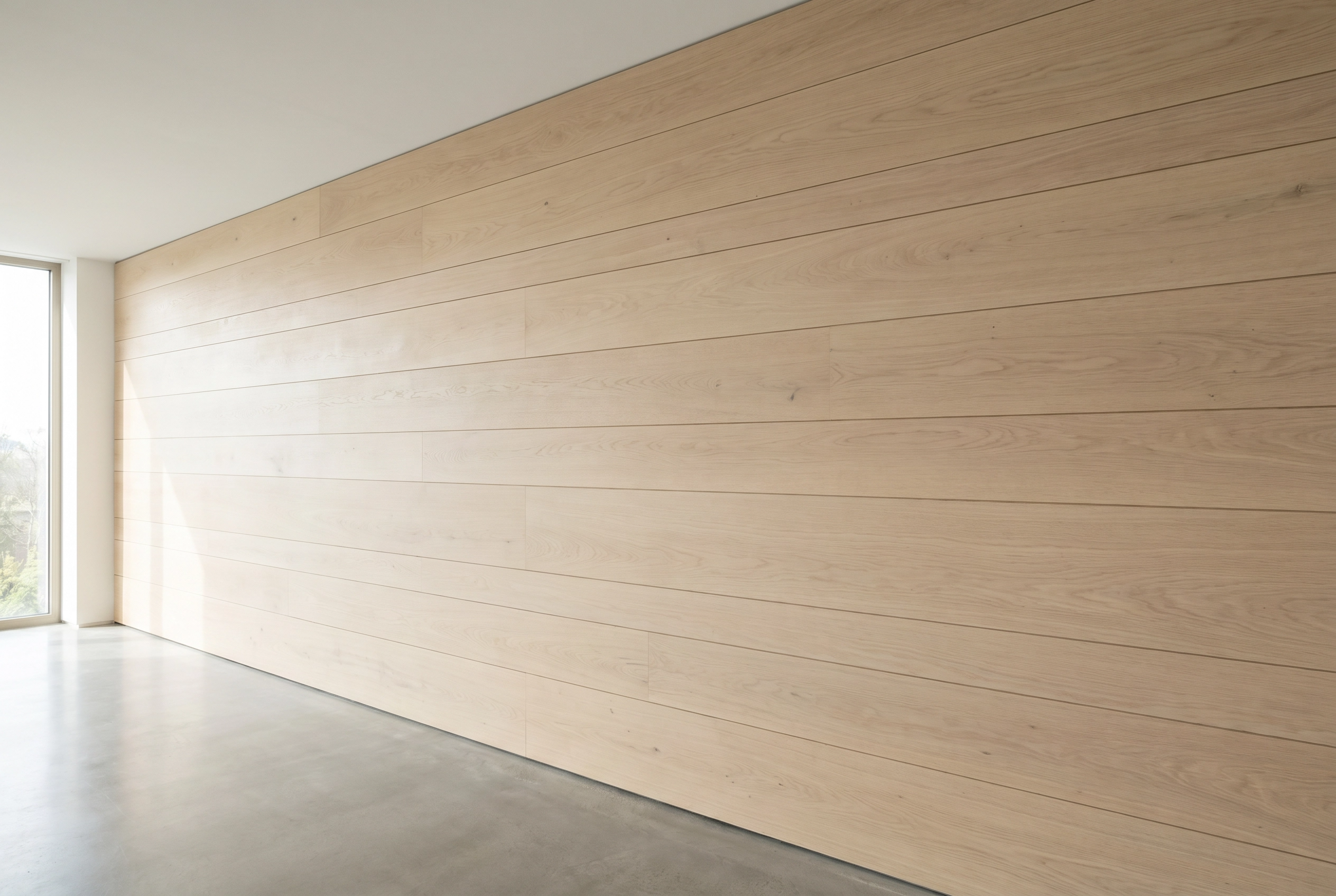
Consistent grading across every wide plank French oak board — the hallmark of single-origin timber processed by a single mill partner.
Grading classifies timber by the presence and size of natural features such as knots, sapwood, and colour variation. In wide plank specification, these features are more prominent because each board covers a larger surface area. Inconsistent grading — common in mixed-batch timber from multiple suppliers — produces an application that looks patchy or visually unresolved. As a result, the design intent suffers.
Single-origin French oak goes through rigorous and uniform grading at Cheneoak’s French mill partner. This means the specified grade arrives consistently across the entire project order. For architects, this predictability is invaluable. It allows precise control over the visual texture of the space and ensures the installed floor matches the approved sample.
The choice of grade depends entirely on the architectural vision. Prime grades feature minimal knots and a uniform colour. They suit clean, contemporary, minimalist interiors. Character grades include more natural features — larger knots and subtle colour variation — so they add warmth and texture to the space. Rustic grades embrace the full natural character of the oak. They work well in heritage or industrial-inspired designs.
The uniform blond tone of Burgundy oak provides a versatile foundation across all grades. Consequently, architects can achieve a wide range of finishes and treatments without artificial tinting. The consistent grading ensures that the final installed floor reflects the design intent precisely — a critical requirement for premium residential and commercial projects where every detail is scrutinised.
The finish applied to wide plank French oak protects the timber and shapes its final appearance. Therefore, the choice of finish must balance aesthetic preferences with practical needs such as durability and maintenance. Common options include hardwax oils, and invisible or raw-look lacquers.
Hardwax oils penetrate the timber and enhance the natural grain. They produce a matte, tactile surface that is easy to spot-repair. This is a key advantage of the Cheneoak prefinished board, which uses a no-VOC hard wax oil system. Polyurethanes form a protective film on the surface and offer high durability for high-traffic areas. For architects who want to preserve the natural, unfinished look of single-origin French oak, invisible lacquers deliver robust protection without changing the timber’s raw character.
The successful execution of a wide plank French oak specification relies on correct subfloor preparation and a proven installation method that respects the timber’s natural movement.
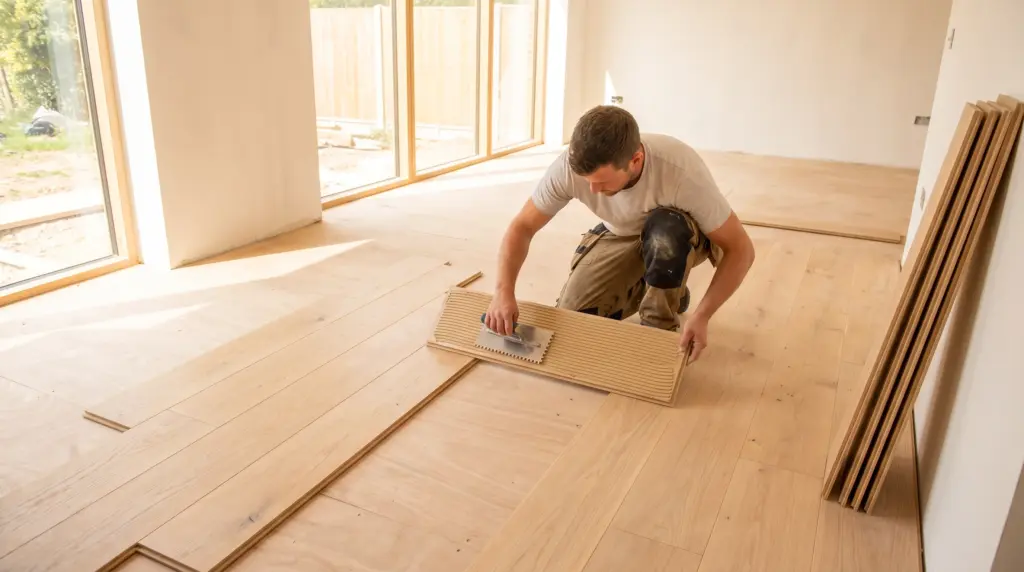
Correct installation of wide plank French oak: plywood substrate as moisture barrier, adhesive trowelled onto the board back, and secret nailing to fix in place.
Before laying any wide plank French oak, the installer must cover the entire floor with a plywood substrate. This plywood layer acts as the critical moisture barrier between the concrete slab and the timber. It stops ground moisture from migrating into the boards and damaging the floor’s long-term stability. The installer must lay the plywood edge to edge across the full floor area, leaving no concrete exposed.
The plywood substrate also gives the oak boards a flat, stable nailing surface. Architects must specify that the plywood meets strict flatness tolerances — typically within 3mm over a 3-metre radius — before the oak installation starts. In addition, the installer must test and document the moisture content of both the subfloor and the plywood prior to installation. Excess moisture negates the inherent wide plank French oak stability that makes this timber so well suited to wide-width applications.
One of the installation methods for wide plank French oak combines adhesive and secret nailing. Cheneoak does not recommend or warranty floors that use direct stick with rigid adhesives. Instead, the installer must trowel a flexible adhesive — Bostik or Sikaflex — onto the back of each board before laying it onto the plywood substrate. The notched trowel ensures even coverage and accommodates the minute natural movement of the timber.
Once the installer presses the board into position, they secret-nail it through the tongue using a flooring nail gun. This two-method approach — glue and nail — creates a secure, stable bond while accommodating the seasonal movement all timber undergoes. As a result, the floor delivers superior acoustic performance and a solid, premium feel underfoot that reflects the quality of the single-origin French oak.
Despite the exceptional wide plank French oak stability that old-growth age and tannin content provide, all timber undergoes some degree of seasonal movement. Therefore, the installer must incorporate expansion gaps of 10–15mm around the entire perimeter of the floor and at all fixed vertical obstacles such as columns and door frames.
The detailing of these gaps is critical for a refined architectural finish. Skirting boards, shadow lines, or custom trims must conceal the expansion gaps while letting the floor move freely. In this way, the technical requirements of the flooring system do not compromise the visual resolution of the interior. For full installation specifications and NatSpec clauses, registered specifiers can access all documentation via the Cheneoak Specifier Portal.

